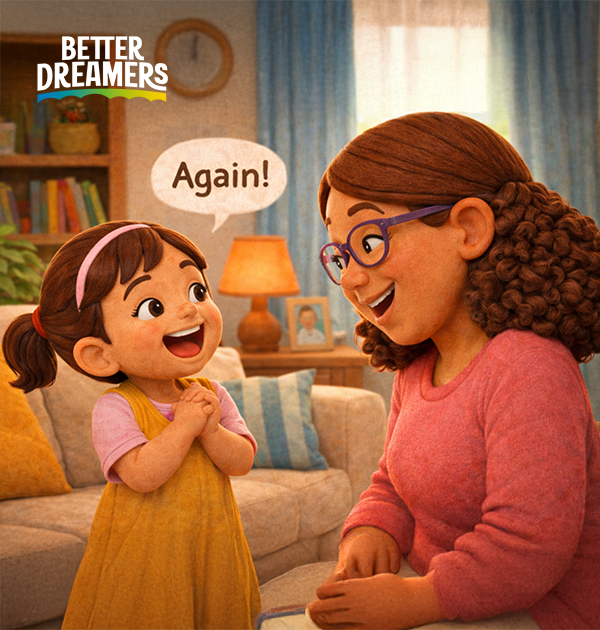
If your child asks for the same story for the tenth night in a row, you might wonder,
“Aren’t they bored yet?”
Interestingly, they’re not.
In fact, child-development experts have known this for a long time:
repetition is how young brains learn, feel safe, and make meaning.
And stories are one of the most powerful places where this happens.
Familiar Stories Help the Brain Feel Safe
Young children are still learning how the world works.
Everything is new. Everything changes.
Developmental psychologists often talk about how predictability helps regulate a child’s nervous system. When a child knows what’s coming next, their brain can relax.
A familiar story does exactly that.
Same beginning.
Same middle.
Same ending.
That predictability creates a sense of safety — and safety is where learning happens best.
Research Shows Children Learn More From Repeated Stories
Studies in early childhood language development have shown something surprising:
children often understand more vocabulary and story meaning when they hear the same story multiple times, rather than many different stories once.
The first time, they’re just listening.
The next few times, they start noticing details.
Then emotions.
Then patterns.
Repetition gives the brain space to go deeper instead of wider.
Repetition Builds Confidence, Not Dependence
Some parents worry that repetition means their child isn’t ready to move on.
But research in child psychology shows the opposite.
When children return to something familiar, it’s often because they feel confident enough to explore it more deeply.
They predict lines.
They recognise emotions.
They feel capable.
That quiet confidence is incredibly important in early development.
Emotional Processing Happens in Layers
Children don’t process emotions all at once.
A story about fear, kindness, jealousy, or disappointment may feel big the first time. Repetition allows children to revisit those emotions safely.
Child therapists often use repeated storytelling for this very reason — it lets children explore feelings without being overwhelmed.
Each replay helps them make sense of what they felt last time.
The Brain Loves Patterns — Especially in Early Childhood
Neuroscience tells us that young brains are wired to look for patterns.
Repeated stories provide:
- familiar language rhythms
- predictable emotional arcs
- consistent cause-and-effect
These patterns strengthen memory, comprehension, and emotional understanding.
This is one reason why children often ask for the exact same wording — changing it can feel unsettling to them.
Why Audio Stories Make Repetition Even More Powerful
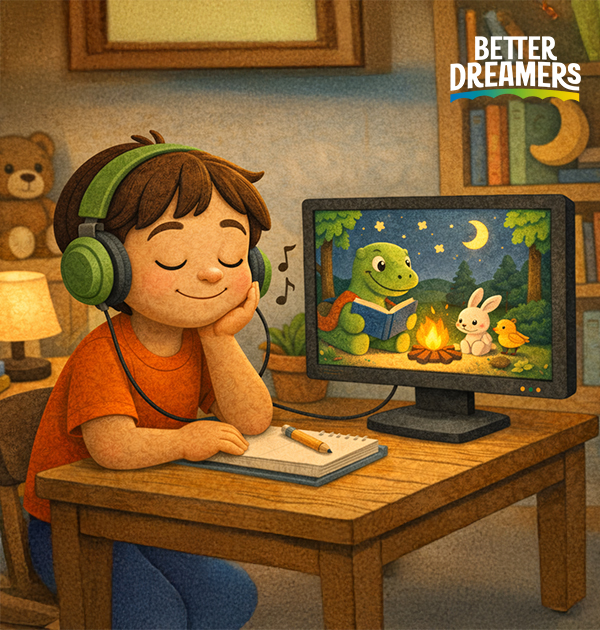
With audio stories, children aren’t distracted by visuals.
They imagine.
They listen.
They feel.
This allows the brain to focus on language, emotion, and meaning — which is why educators often recommend listening-based storytelling for early development.
When the pacing is slow and gentle, repetition becomes soothing instead of overstimulating.
Where Better Dreamers Fits In
Better Dreamers stories are intentionally designed for repeat listening.
They are:
- calm and predictable
- emotionally safe
- slow enough for understanding
- simple enough for comfort
So when a child asks for the same story again, it’s not a habit to break.
It’s a developmental signal.
A signal that the story feels safe.
That it’s helping them understand something.
That it belongs to them now.
The Next Time They Ask for “One More Time”
You’re not indulging them.
You’re supporting how their brain learns.
How their emotions settle.
How their confidence grows.
Repetition isn’t a phase to rush through.
It’s part of the magic.