“Good stories raise good humans.”
It sounds like a nice line.
The kind you nod at, maybe even save… and move on.
But if you sit with it for a moment, you realise something deeper is going on.
This isn’t a quote meant to impress.
It’s a quiet observation about how children actually grow.
Stories Are How Humans Have Always Learned to Be Human
Long before classrooms, apps, or textbooks, humans learned values through stories.
Around fires.
At bedtime.
Through grandparents, parents, and elders.
Stories weren’t entertainment.
They were how children learned:
- what kindness looks like
- how courage feels
- why honesty matters
- what happens when we hurt someone
- how to make things right
We didn’t explain values.
We showed them — through characters, choices, and consequences.
That hasn’t changed. Only the noise around it has.
Children Don’t Learn Values From Instructions. They Learn From Experience.
You can tell a child to “be kind” a hundred times.
But one story about a character who comforts someone else?
That lands differently.
Because stories don’t teach through authority.
They teach through experience.
When a child listens to a story, they don’t stand outside it.
They step inside it.
They feel what the character feels.
They worry when the character worries.
They feel relief when things turn out okay.
That emotional experience is what shapes behaviour later.
Stories Build the Inner Compass
Good stories don’t just show what to do.
They quietly shape why we do it.
They help children develop an inner compass — not one driven by fear or reward, but by understanding.
A child who grows up with good stories learns:
- to pause before reacting
- to consider another person’s feelings
- to recognise right from wrong even when no one is watching
That’s not obedience.
That’s character.
Stories Shape Empathy Before Logic Arrives
Young children don’t reason like adults.
Their world is emotional before it is logical.
Stories meet them exactly where they are.
When a character feels left out, scared, jealous, or proud, children recognise those feelings — sometimes before they can name them in themselves.
That’s how empathy begins.
Not through lectures.
Through shared feeling.
Good Stories Stay With Us — Long After Childhood
Think about it.
Most of us don’t remember the rules we were taught.
But we remember the stories.
The brave one.
The kind one.
The one who made a mistake and tried again.
Those stories quietly shape how we treat people as adults.
How we show up in relationships.
How we make choices under pressure.
That’s the long game of storytelling.
Why This Matters Even More Today
Today’s children grow up in a fast, noisy world.
They’re surrounded by content — but not always meaning.
Information — but not always wisdom.
Good stories slow things down.
They offer:
- calm instead of chaos
- reflection instead of reaction
- connection instead of consumption
They give children space to think, feel, and grow from the inside out.
Where Better Dreamers Comes In
Better Dreamers believes this line deeply — not as a tagline, but as a responsibility.
That’s why the stories are:
- gentle, not loud
- emotional, not flashy
- thoughtful, not rushed
- human, not hyper
They don’t try to teach morals aggressively.
They simply show children what it looks like to be kind, brave, honest, and thoughtful — and let the learning happen naturally.
Because values absorbed gently… last longer.
So No, It’s Not Just a Quote
“Good stories raise good humans” isn’t poetry.
It’s practice.
It’s parenting.
It’s a long-term investment in who a child becomes.
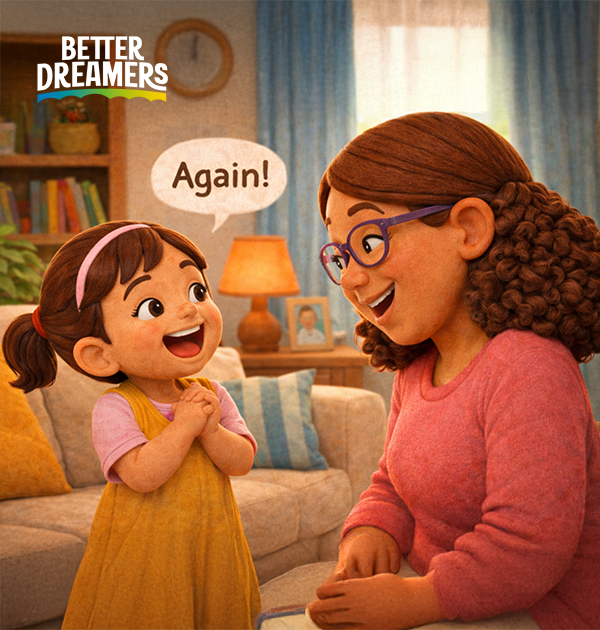
And every time a child listens to a good story — especially one they return to again and again — that work is quietly happening.
One story at a time.